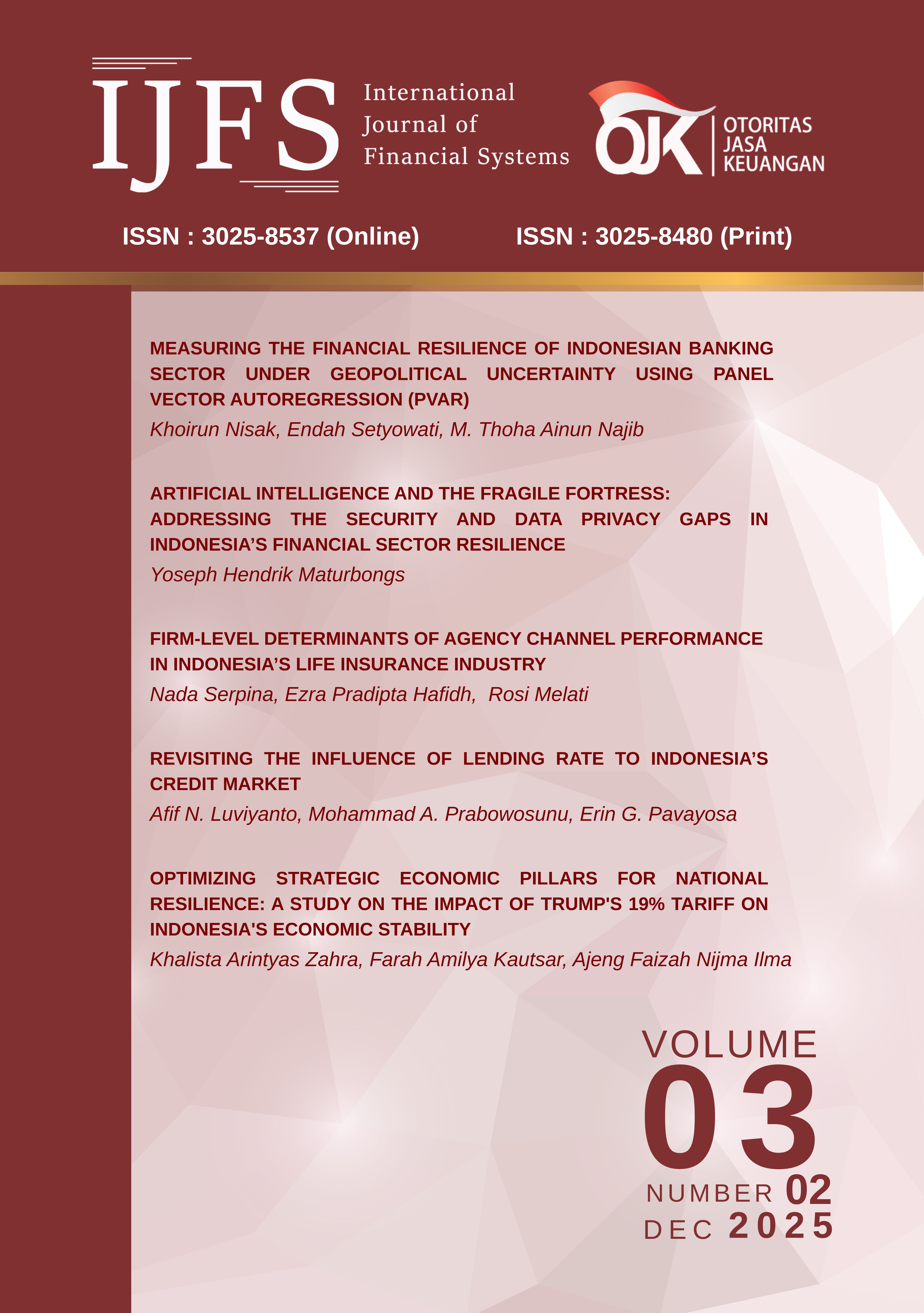
Revisiting the Influence of Lending Rate to Indonesia’s Credit Market
DOI:
https://doi.org/10.61459/ijfs.v3i2.91Keywords:
Lending Rate, Credit Volume, Monetary TransmissionAbstract
This paper investigates the responsiveness of credit volumes to changes in lending rates in Indonesia and reexamines the strength of the monetary transmission mechanism through the credit channel. Using a vector autoregression framework applied to disaggregated bank credit data by sector, loan type, and firm size, we analyse how policy-driven interest rate movements propagate into actual lending outcomes. The results reveal a markedly uneven transmission: credit to micro, small, and medium enterprises (MSMEs) shows negligible sensitivity to interest rate changes, whereas lending to large firms responds more appreciably. In particular, bank credit to large corporates declines significantly when policy rates rise, consistent with conventional theory, while credit to smaller firms remains largely unaltered. These findings suggest that the traditional interest rate pass-through is fragmented and weak in key segments of the economy, undermining the efficacy of pricebased monetary policy. The analysis points to structural factors, including heterogeneous bank behaviour, borrower constraints, and a propensity of banks to shift toward safer assets in uncertain times as underlying causes. The findings imply the need for a more nuanced policy approach that complements interest rate adjustments with targeted interventions to achieve broad-based credit stimulus and effective monetary control.
Downloads
References
Abedifar, P., Molyneux, P., & Tarazi, A. (2013). Risk in islamic banking. Review of Finance, 17(6), 2035-2096. https://doi.org/10.1093/rof/rfs041
Aginta, H., & Someya, M. (2022). Regional economic structure and heterogeneous effects of monetary policy: Evidence from Indonesian provinces. Journal of Economic Structures, 11(1), 1-17. https://doi.org/10.1186/s40008-021-00260-6
Alessandri, P., & Bottero, M. (2020). Bank lending in uncertain times. European Economic Review, 128, 103503. https://doi.org/10.1016/j.euroecorev.2020.103503
Altavilla, C., Boucinha, M., Holton, S., & Ongena, S. (2020). Monetary policy and bank profitability in a low-interest rate environment. Economic Policy, 33(96), 531-586. https://doi.org/10.1093/epolic/eiy013
Altavilla, C., Canova, F., & Ciccarelli, M. (2020). Mending the broken link: Heterogeneous bank lending rates and monetary policy pass-through. Journal of Monetary Economics, 110, 81-98. https://doi.org/10.1016/j.jmoneco.2019.01.001
Avdjiev, S., & Hale, G. (2019). US monetary policy and fluctuations of international bank lending. Journal of International Money and Finance, 95, 251-268. https://doi.org/10.1016/j.jimonfin.2018.06.013
Becker, B., & Ivashina, V. (2018). Financial repression in the European sovereign debt crisis. Review of Finance, 22(1), 83-115. https://doi.org/10.1093/rof/rfx041
Bernanke, B. S., & Blinder, A. S. (1988). Credit, money, and aggregate demand. American Economic Review, 78(2), 435-439.
Bernanke, B. S., & Gertler, M. (1995). Inside the black box: The credit channel of monetary policy transmission. Journal of Economic Perspectives, 9(4), 27-48. https://doi.org/10.1257/jep.9.4.27
Bernanke, B. S., Gertler, M., & Gilchrist, S. (1999). The financial accelerator in a quantitative business cycle framework. In J. B. Taylor & M. Woodford (Eds.), Handbook of Macroeconomics (Vol. 1C, pp. 1341-1393). https://doi.org/10.1016/S1574-0048(99)10034-X
Buch, C. M., Buchholz, M., & Tonzer, L. (2015). Uncertainty, bank lending, and bank-level heterogeneity. IMF Economic Review, 63(4), 919-954. https://doi.org/10.1057/imfer.2015.35
Byrne, D., & Foster, S. (2023). Transmission of monetary policy: Bank interest rate pass-through in Ireland and the Euro area (Economic Letter No. 3/EL/23). Central Bank of Ireland.
Borio, C., & Zhu, H. (2012). Capital regulation, risk-taking and monetary policy: A missing link in the transmission mechanism? Journal of Financial stability, 8(4), 236-251. https://doi.org/10.1016/j.jfs.2011.12.003
Checo, A., Grigoli, F., & Sandri, D. (2024). Monetary policy transmission in emerging markets: Proverbial concerns, novel evidence (BIS Working Paper No. 1170). Bank for International Settlements.
Cloyne, J., Ferreira, C., & Surico, P. (2020). Monetary policy when households have debt: New evidence on the transmission mechanism. Review of Economic Studies, 87(1), 102-129. https://doi.org/10.1093/restud/rdy074
European Central Bank (ECB). (2022). The transmission of monetary policy in the Euro area. ECB Economic Bulletin, Issue 4. https://www.ecb.europa.eu/press/key/date/2022/html/ecb.sp221011~5062b44330.en.html
Gambacorta, L., & Marques-Ibanez, D. (2011). The bank lending channel: Lessons from the crisis (BIS Working Papers No. 345). Bank for International Settlements.
Gambacorta, L., & Shin, H. S. (2018). Why bank capital matters for monetary policy. Journal of Financial Intermediation, 35, 17-29. https://doi.org/10.1016/j.jfi.2016.09.005
Gennaioli, N., Martin, A., & Rossi, S. (2018). Banks, government bonds, and default: What do the data say? Journal of Monetary Economics, 98, 98-113. https://doi.org/10.1016/j.jmoneco.2018.04.011
Kreamer, J. (2022). Sectoral heterogeneity and monetary policy. American Economic Journal Macroeconomics, 14(2), 123-159. https://doi.org/10.1257/mac.20190248
Mishkin, F. S. (1996). The channels of monetary transmission: Lessons for monetary policy. NBER Working Paper No. 5464. https://doi.org/ 10.3386/w5464
Naiborhu, E. D. (2024). The lending implications of loan loss provisioning and monetary policy in Indonesia. Pacific Basin Finance Journal, 86, Article 102446. https://doi.org/10.1016/j.pacfin.2024.102446
Ottonello, P., & Winberry, T. (2020). Financial heterogeneity and the transmission of monetary policy. Econometrica, 88(6), 2473-2502. https://doi.org/10.3982/ECTA15949
Pamungkas, P., Septianto, F., Trinugroho, I., Ab Rahim, R., Ridhwan, M. M., & Sergi, B. S. (2025). Monetary policy via bank lending channel: Evidence from lending decomposition. Journal of Risk and Financial Management, 18(5), 249. https://doi.org/10.3390/jrfm18050249
Pietrovito, F., & Pozzolo, A. F. (2023). Did small banks trade off lending with government bond purchases during the sovereign debt crisis? International Review of Economics & Finance, 86, 666-683. https://doi.org/10.1016/j.iref.2023.03.041
Sapriza, H., & Temesvary, J. (2024). Economic activity and the bank credit channel. Journal of Banking & Finance, 164, 107216. https://doi.org/10.1016/j.jbankfin.2024.107216
Segev, N., & Schaffer, M. (2020). Monetary policy, bank competition and regional credit cycles: Evidence from a quasi-natural experiment. Journal of Corporate Finance, 64, 101494. https://doi.org/10.1016/j.jcorpfin.2019.101494
Downloads
Published
How to Cite
Issue
Section
License
Copyright (c) 2026 The International Journal of Financial Systems

This work is licensed under a Creative Commons Attribution-NonCommercial 4.0 International License.
IJFS article's license is CC-BY-NC. Authors grant the journal/publisher publishing rights with the work simultaneously licensed under a Creative Commons Attribution-NonCommercial 4.0 International License.