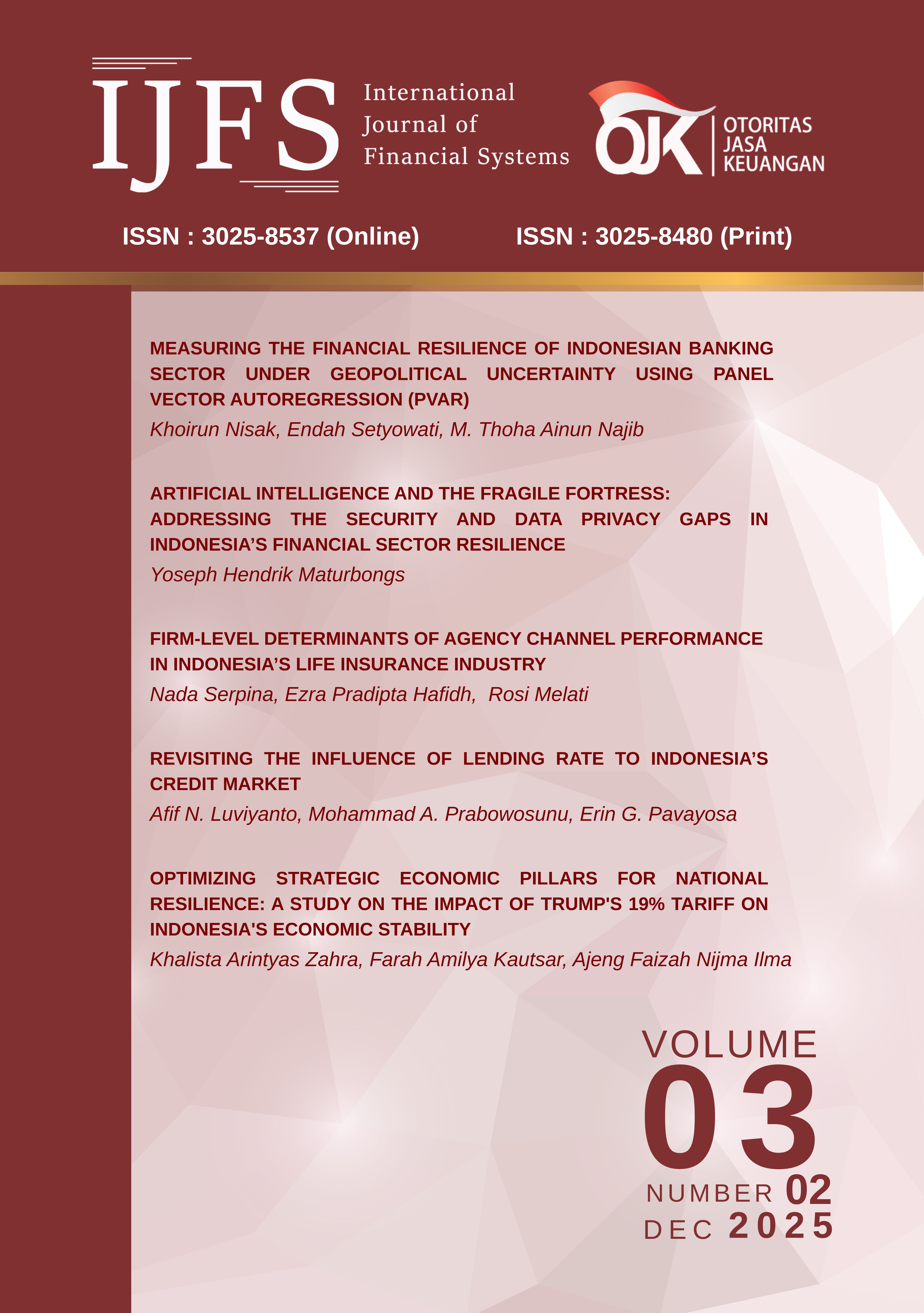
Measuring the Financial Resilience of Indonesian Banking Sector under Geopolitical Uncertainty Using Panel Vector Autoregression (PVAR)
DOI:
https://doi.org/10.61459/ijfs.v3i2.88Keywords:
Geopolitical Risk, Banking Resilience, Profitability, Capital Adequacy, Panel VARAbstract
Geopolitical tensions can affect the stability of companies, including Indonesia's banking sector. Geopolitical risk, as measured by the Geopolitical Risk Index (GRI), is an external factor that reflects economic and political uncertainty arising from global adverse events. This study aims to understand the dynamics of the interaction of geopolitical risk on the stability of banking indicators, including ROA, ROE, CAR, and NPL. Furthermore, this study aims to assess financial resilience in the banking sector amid geopolitical tensions. Sampling was conducted across banking categories, including KBMI 4, KBMI 3, Islamic banks, and regional development banks. The data used are quarterly panel time series from 2015 to 2024. The analysis was conducted using Panel Vector Autoregression (PVAR) with the Generalised Method of Moments (GMM) approach. The results show that the impact of the GRI shock on banking indicators is short to medium-term, with the most significant effects on profitability (ROA, ROE) and credit quality (NPL). The results confirm that global geopolitical pressures play a dominant role in explaining fluctuations in bank indicators in Indonesia, particularly capital efficiency and capital structure. Based on the dynamics of these interactions, Bank A, Bank B, Bank D, and Bank E are classified as more resilient, and Bank C, Bank F, Bank G, and Bank H are classified as less resilient. More resilient banks are characterised by a low GRI impact on ROA and CAR, and a quick return to stability, while less resilient banks have a high GRI impact on ROE and CAR.
Downloads
Download data is not yet available.
References
Aris, A. (2024, November 28). Fitch afirmasi peringkat Bank OCBC NISP di BBB outlook stabil. Media Asuransi News. https://mediaasuransinews.co.id/market/fitch-afirmasi-peringkat-bank-ocbc-nisp-di-bbb-outlook-stabil/
Adra, S., Gao, Y., Huang, J., & Yuan, J. (2023). Geopolitical risk and corporate payout policy. International Review of Financial Analysis, 87, 102613. https://doi.org/10.1016/j. irfa.2023.102613
Alam, A. W., Houston, R., & Farjana, A. (2023). Geopolitical risk and corporate investment: How do politically connected firms respond? Finance Research Letters, 53, 103681. https://doi. org/10.1016/j.frl.2023.103681
Alsagr, N., & Almazor, S. F. V. H. (2020). Oil rent, geopolitical risk and banking sector performance. International Journal of Energy Economics and Policy, 10(5), 305–314. https://doi. org/10.32479/ijeep.9668
Andrews, D. W. K., & Lu, B. (2001). Consistent model and moment selection procedure for GMM estimation with application to dynamic panel data models. Journal of Econometrics, 101(1), 123–164. https://doi.org/10.1016/S0304-4076(01)00077-4
Andriani, E., Ashsifa, I., & Kuncoro, M. T. (2024). How geopolitical, credit and financial risks define ASEAN banks’ performance? Jurnal Ilmiah Manajemen, Ekonomi, & Akuntansi (MEA), 8(2), 2087–2105. https://doi.org/10.31955/mea.v8i2.4297
Aprilia, Z. (2024, January 25). Ditopang dana murah (CASA), BCA himpun Rp 1.102 T dana pihak ketiga. CNBC Indonesia. https://www.cnbcindonesia.com/market/20240125161908-17-509013/ditopang-dana-murah-casa-bca-himpun-rp-1102-t-dana-pihak-ketiga
Badan Pusat Statistik. (2024). Statistik lembaga keuangan 2022/2023 (No. 25). Badan Pusat Statistik Republik Indonesia. https://www.bps.go.id/id/publication/2024/01/24/da4191eabfa9e48fd34409e0/statistik-lembaga-keuangan-2022-2023.html
Bank Indonesia. (2024). Menjaga resiliensi, melanjutkan momentum pertumbuhan. Bank Indonesia, Bank Sentral Republik Indonesia. https://www.bi.go.id/KSK/Documents/KSK_4324_.pdf
Banna, H., Alam, A., Alam, A. W., & Chen, X. H. (2023). Geopolitical uncertainty and banking risk: International evidence. SSRN. https://doi.org/10.2139/ssrn.4325966
Behn, M., Lang, J. H., & Reghezza, A. (2025). 120 years of insight: Geopolitical risk and bank solvency. Economics Letters, 247, 112168. https://doi.org/10.1016/j.econlet.2025.112168
Bilgin, M. H., Danisman, G. O., Demir, E., & Tarazi, A. (2021). Economic uncertainty and bank stability: Conventional vs. islamic banking. Journal of Financial Stability, 56, 100911. https:// doi.org/10.1016/j.jfs.2021.100911
Bossman, A., & Gubareva, M. (2023). Asymmetric impacts of geopolitical risk on stock markets: A comparative analysis of the E7 and G7 equities during the Russian-Ukrainian conflict. Heliyon, 9(2), e13626. https://doi.org/10.1016/j.heliyon.2023.e13626
Caglayan, M., & Xu, B. (2019). Economic policy uncertainty effects on credit and stability of financial institutions. Bulletin of Economic Research, 71(3), 342–347. https://doi.org/10.1111/ boer.12175
Caldara, D., & Lacoviello, M. (2022). Measuring geopolitical risk. American Economic Review, 112(4), 1194–1225. https://doi.org/10.1257/aer.20191823
Canova, F., & Ciccarelli, M. (2013). Panel vector autoregressive models: A survey. Emerald Group Publishing Limited., 32, 205–246.
Carney, R. W., Ghoul, S. E., Guedhami, O., & Wang, H.H. (2024). Geopolitical risk and the cost of capital in emerging economies. Emerging Markets Review, 61, 101149.
https://doi.org/10.1016/j.ememar.2024.101149
Daganzo, C. F., Gayah, V. V., & Gonzales, E. J. (2012). The potential of parsimonious models for understanding large-scale transportation systems and answering big picture questions. EURO Journal on Transportation and Logistics, 1(1–2), 47–65.
https://doi.org/10.1007/s13676-012-0003-z
De Sybel, R. (2024). Navigating the storm: The intersection of geopolitical and financial crime risks. Journal of Risk Management in Financial Institutions, 17(3), 294. https://doi.org/10.69554/ PMDH1565
Demir, E., & Danisman, G. O. (2021). The impact of economic uncertainty and geopolitical risks on bank credit. The North American Journal of Economics and Finance, 57, 101444. https://doi. org/10.1016/j.najef.2021.101444
Desogus, E., Grosso, D., Bompard, E., & Lo Russo, S. (2023). Modelling the geopolitical impact on risk assessment of energy supply system: The case of Italian crude oil supply. Energy, 284. https://doi.org/10.1016/j.energy.2023.128578
Dickey, D. A., & Fuller, W. A. (1981). Likelihood ratio statistics for autoregressive time series with a unit root. Econometrica, 49(4), 1057-1072. https://doi.org/10.2307/1912517
Fianto, B. A., & Ibrahim, M. H. (2025). Bank lending amid geopolitical risk: The GCC case. Review of Financial Economics, 43(4), 608–628. https://doi.org/10.1002/rfe.70017
Geopolitical Futures. (2025). 2025 Outlook for the global economy. https://geopoliticalfutures.com/2025-outlook-for-the-global-economy/
Ginn, W., & Saadaoui, J. (2025). Impact of geopolitical risks on equity returns. SSRN. http://dx.doi. org/10.2139/ssrn.5049305
Hodula, M., Janků, J., Malovana, S., & Ngo, N. A. (2024). Geopolitical risks and their impact on global macro-financial stability: Literature and measurements. SSRN. https://doi.org/10.2139/ ssrn.4968346
Holtz-Eakin, D., Newey, W., & Rosen, H. S. (1988). Restimating vector autoregressions with panel data. Econometrica, 56(6), 1371–1395. https://doi.org/10.2307/1913103
Institute for International Trade. (2023). Geopolitical tensions and economic fragmentation: A trade policy response. University of Adelaide. https://iit.adelaide.edu.au/ua/media/2166/iit-pb-20-geopolitical-tensions-and-economic-fragmentation-final-4.pdf
International Monetary Fund. (2023). IMF Annual Report 2023. https://www.imf.org/external/pubs/ft/ar/2023/
International Monetary Fund. Monetary and Capital Markets Department. (2025). Global financial stability report, April 2025: Enhancing resilience amid uncertainty. International Monetary Fund. https://doi.org/10.5089/9798229003261.082
Jaelani, A. (2023). The effect of CAR and NPL on ROA in banking companies listed on the Indonesia Stock Exchange for the 2019-2022 period. International Journal of Management Studies and Social Science Research, 5(4), 111–118. https://doi.org/10.56293/ijmsssr.2022.4667
Kudrna, Z., & Gabor, D. (2013). The return of political risk: Foreign-owned banks in emerging Europe. Europe-Asia Studies, 65(3), 548–566. https://doi.org/10.1080/09668136.2013.779458
Kumar, S., & Rao, A. (2024). Assessing and mitigating the impact of geopolitical risk uncertainty on the Indian financial sector: A policy perspective. Bulletin of Monetary Economics and Banking, 27(3), 483–526. https://doi.org/10.59091/2460-9196.2278
Kustodian Sentral Efek Indonesia. (2024). Statistik Pasar Modal Indonesia. https://web.ksei.co.id/files/Statistik_Publik_Desember_2024_v3.pdf
Le, A.-T., & Tran, T. P. (2021). Does geopolitical risk matter for corporate investment? Evidence from emerging countries in Asia. Journal of Multinational Financial Management, 62, 100703. https://doi.org/10.1016/j.mulfin.2021.100703
Lestari, S., & Mutmainah, S. (2024). Resilience reinforced: An in-depth analysis of bank syariah Indonesia’s post-merger performance. Jurnal Akuntansi dan Bisnis, 24(1), 137-156. https://doi.org/10.20961/jab.v24i1.1215
Liu, C. X. (2021). Research review on vector autoregressive model for panel data. Statistics & Decisions, 2, 25–29. https://doi.org/10.13546/j.cnki.tjyjc.2021.02.005
Love, I., & Zicchino, L. (2006). Financial development and dynamic investment behavior: Evidence from panel VAR. The Quarterly Review of Economics and Finance, 46(2), 190–210. https://doi. org/10.1016/j.qref.2005.11.007
Luca, G. D., Del Gaudio, B. L., & Di Iorio, A. P. (2025). Geopolitical risk and financial stress. The North American Journal of Economics and Finance, 80, 102510. https://doi.org/10.1016/j. najef.2025.102510
Nadia, L. P., Krisnanda, K., Sa’adah, W. N., & Yasin, R. M. (2024). Do geopolitical risk and economic uncertainty harm bank credit? Evidence from the Indonesian bank. Jurnal Riset Ilmu Ekonomi, 4(1), 58–74. https://doi.org/10.23969/jrie.v4i1.121
Nițescu, D. C., Călin, A. E., Bozagiu, A. M., & Vierescu, E. M. (2025). Navigating turbulence: Unveiling the spillover effects between non-financial risks and banks. Economic Computation & Economic Cybernetics Studies & Research, 59(1), 86-103.
Nguyen, T. C., & Thuy, T. H. (2023). Geopolitical risk and the cost of bank loans. Finance Research Letters, 54, 103812. https://doi.org/10.1016/j.frl.2023.103812
Nguyen, X. T., Nguyen, T. C., & Hoang, H. V. (2025). Geopolitical risk and corporate investment efficiency. Finance Research Letters, 78. https://doi.org/10.1016/j.frl.2025.107112
NguyenHuu, T., & Örsal, D. K. (2024). Geopolitical risks and financial stress in emerging economies. The World Economy, 47(1), 217–237. https://doi.org/10.1111/twec.13529
Olalere, O. E., & Mukuddem-Petersen, J. (2024). Geopolitical risk, economic policy uncertainty, and bank stability in BRICS countries. Cogent Economics & Finance, 12(1), 1-20. https://doi.org/10.1080/23322039.2023.2290368
Phan, D. H. B., Tran, V. T., & Iyke, B. N. (2022b). Geopolitical risk and bank stability. Finance Research Letters, 46(B). https://doi.org/10.1016/j.frl.2021.102453
Ruza, C., De La Cuesta-González, M., & Paredes-Gazquez, J. (2019). Banking system resilience: An empirical appraisal. Journal of Economic Studies, 46(6), 1241–1257. https://doi.org/10.1108/ JES-06-2018-0199
Shabir, M., Jiang, P., Shahab, Y., & Wang, P. (2023). Geopolitical, economic uncertainty and bank risk: Do CEO power and board strength matter? International Review of Financial Analysis, 87, 102603. https://doi.org/10.1016/j.irfa.2023.102603
Sivaprasad, S., Adami, R., Malki, I., Ibragimova, D., & Yodgorova, F. (2025). Spillover effects of geopolitical risk on the banking sectors of post-Soviet countries. Review of Behavioral Finance, 17(3), 544–562. https://doi.org/10.1108/RBF-01-2025-0026
Suada A. Džogović and Zijad Šabotić. (2024). Geopolitical tensions and their impact on the international economy: A case study of the Russian-Ukrainian conflict. Journal of Economic Cooperation and Development, 45(3), 31-64.
Supari, S., & Anton, H. (2022). The impact of the national economic recovery program and digitalization on MSME resilience during the covid-19 pandemic: A case study of Bank Rakyat Indonesia. Economies, 10(7), 160. https://doi.org/10.3390/economies10070160
Umar, Z., Bossman, A., Choi, S.-Y., & Teplova, T. (2022). Does geopolitical risk matter for global asset returns? Evidence from quantile-on-quantile regression. Finance Research Letters, 48(2), 102991. https://doi.org/10.1016/j.frl.2022.102991
Vinus, M., & Kusairi, S. (2017). Investigation of external and internal shock in the stability of Indonesia’s financial system. Risk Governance and Control: Financial Markets and Institutions, 7(3), 6–16. https://doi.org/10.22495/rgcv7i3p1
Vuong, G. T. H., Nguyen, Y. D. H., Nguyen, M. H., & Wong, W.-K. (2024). Assessing the impact of macroeconomic uncertainties on bank stability: Insights from ASEAN-8 countries. Heliyon, 10(11), e31711. https://doi.org/10.1016/j.heliyon.2024.e31711
Wang, Y., Song, G., & Lu, Y. (2025). Geopolitical risk, bank regulation, and systemic risk: A cross-country analysis. Finance Research Letters, 76, 106893. https://doi.org/10.1016/j. frl.2025.106893
Yang, R., An, X., Chen, Y., & Yang, X. (2023). The knowledge analysis of panel vector autoregression: A systematic review. SAGE Open, 13(4). https://doi.org/10.1177/21582440231215991
Zhang, B., Liu, Z., Wang, Z., & Zhang, S. (2023). The impact of geopolitical risk on energy security: Evidence from a GMM panel VAR approach. Resources Policy, 86(B), 104222. https://doi.org/10.1016/j.resourpol.2023.104222
Downloads
Published
12/31/2025
How to Cite
Nisak, K., Setyowati, E., & Najib, M. T. A. (2025). Measuring the Financial Resilience of Indonesian Banking Sector under Geopolitical Uncertainty Using Panel Vector Autoregression (PVAR). The International Journal of Financial Systems, 3(2), 111–128. https://doi.org/10.61459/ijfs.v3i2.88
Issue
Section
Articles
License
Copyright (c) 2025 The International Journal of Financial Systems

This work is licensed under a Creative Commons Attribution-NonCommercial 4.0 International License.
IJFS article's license is CC-BY-NC. Authors grant the journal/publisher publishing rights with the work simultaneously licensed under a Creative Commons Attribution-NonCommercial 4.0 International License.