Does Regulation Trigger Volatility?
Empirical Evidence from the Bitcoin, Ethereum, and Ripple Markets in Indonesia
DOI:
https://doi.org/10.61459/ijfs.v4i1.103Keywords:
Volatility, eGARCH, PMK 50/2025, Cryptocurrency, Market ResilienceAbstract
The implementation of PMK 50/2025 marks a pivotal moment in Indonesia’s digital asset fiscal landscape through the introduction of a 0.21% final income tax and the formal transition of oversight to the Financial Services Authority (OJK). This study empirically examines whether these regulatory changes triggered volatility shocks in three major cryptocurrencies: Bitcoin (BTC), Ethereum (ETH), and Ripple (XRP). Using an ARMA(1,1)-eGARCH(1,1) model with Student-t distribution and USD returns as a global market control, we estimate conditional daily volatility over a three-period framework: Pre Announcement, Post-Announcement, and Post-Implementation. Hypothesis testing employs the Wilcoxon Rank-Sum Test (Mann-Whitney U Test), supplemented by dummy regression with Newey-West HAC standard errors, and structural break tests. The primary results reveal no statistically significant change in conditional volatility following PMK 50/2025 for all three assets (Mann Whitney U, all p>0.05). Notably, the dummy regression identifies a statistically significant reduction in Ethereum’s conditional volatility post-implementation (β=−0.000287, p=0.028), corroborated by a structural break toward stability. All assets exhibit a significant positive asymmetry (γ>0), indicating that positive shocks drive greater volatility than negative shocks — a distinctive crypto-market characteristic. Robustness checks using sGARCH(1,1) confirm the main findings. Overall, the results indicate that PMK 50/2025 was not associated with a statistically significant increase in conditional volatility during the observed event windows. These findings should be interpreted as evidence on conditional volatility response only, and do not constitute a comprehensive assessment of market quality, liquidity, or overall resilience.
Downloads
Download data is not yet available.
References
Agrawal, M., Dias, R., Irfan, M., Galvão, R., & Gonçalves, S. (2024). Complex and Multifaceted Nature of Cryptocurrency Markets : A Study to Understand its Time-Varying Volatility Dynamics. Journal of Ecohumanism, 3(4), 3012–3031. https://doi.org/10.62754/joe.v3i4.3819
Auer, R., & Claessens, S. (2018). Regulating cryptocurrencies: assessing market reactions. BIS Quarterly Review, (September), 51–65. https://www.bis.org/publ/qtrpdf/r_qt1809f.htm
Baltagi, B. H., Li, D., & Li, Q. (2006a). Transaction tax and stock market behavior : evidence from an emerging market. Empirical Economics, 408, 393–408. https://doi.org/10.1007/s00181-005-0022-9
Cheikh, N. Ben, Zaiedb, Y. Ben, & Chevallierc, J. (2020). Asymmetric Volatility in Cryptocurrency Markets: New evidence from Smooth Transition GARCH Models. Finance Research Letters, 35, 101293. https://doi.org/10.1016/j.frl.2019.09.008
Du, X., Tang, Z., Wu, J., Chen, K., & Cai, Y. (2022). A New Hybrid Cryptocurrency Returns Forecasting Method Based on Multiscale Decomposition and an Optimized Extreme Learning Machine Using the Sparrow Search Algorithm. IEEE Access, 10, 60397–60411. https://doi.org/10.1109/ACCESS.2022.3179364
Gyamerah, S. A. (2019). Modelling the volatility of Bitcoin returns using GARCH models. Quantitative Finance and Economics, 3(October), 739–753. https://doi.org/10.3934/QFE.2019.4.739
Howden, E. (2015). The Crypto-Currency Conundrum: Regulating an Uncertain Future. Emory International Law Review, 29(4), 742–796. https://scholarlycommons.law.emory.edu/eilr/vol29/iss4/3/
Hussain, I., Ali, N., Bilal, H., & Suhail, A. (2024). Volatility spillover effect between cryptocurrency and stock market using MGARCH BEKK model. Natural and Applied Sciences International Journal (NASIJ), 5(2), 32–55. https://doi.org/10.47264/idea.nasij/5.2.3
Hwang, S., & Valls Pereira, P. L. (2006). Small sample properties of GARCH estimates and persistence. European Journal of Finance, 12(6–7), 473–494. https://doi.org/10.1080/13518470500039436
Kantar, L., Azimova, T., Akkaya, M., & Yildirim, H. H. (2025). Bitcoin, Gold, and Stock Market Volatility Including COVID-19 Periods : Comparative Analysis Using GARCH and DCC-MGARCH Models. Revista Finanzas y Política Económica, 17, 1–36.
Kothari, S. P., Warner, J. B., & Simon, W. E. (2007). Econometrics of Event Studies *. Handbooks in Finance, 1. https://doi.org/10.1016/B978-0-444-53265-7.50015-9
Li, H., Tang, M., Shang, W., & Wang, S. (2013). Securities Transaction Tax and Stock Market Behavior in an Agent-based Financial Market Model. Procedia Computer Science, 18, 1764–1773. https://doi.org/10.1016/j.procs.2013.05.345
Naimy, V., Haddad, O., & Ferna, G. (2021). The predictive capacity of GARCH-type models in measuring the volatility of crypto and world currencies. PLoS ONE, 16(1), 1–17. https://doi.org/10.1371/journal.pone.0245904
Nurdin, M., & Utomo, H. B. (2026). The Crypto Tax Shift : Analyzing Financial and Compliance Impacts on a Public Indonesian Exchange. Journal of Informatics, Education and Management, 8(1), 915–919. https://doi.org/10.61992/jiem.v8i1.282
Özdemir, O. (2022). Cue the volatility spillover in the cryptocurrency markets during the COVID 19 pandemic : evidence from DCC GARCH and wavelet analysis. Financial Innovation, 8(12), 1–38. https://doi.org/10.1186/s40854-021-00319-0
Rahman, J., Rahman, H., Islam, N., Tanchangya, T., Ridwan, M., & Ali, M. (2025). Regulatory landscape of blockchain assets: Analyzing the drivers of NFT and cryptocurrency regulation. In BenchCouncil Transactions on Benchmarks, Standards and Evaluations (Vol. 5, Number 1). KeAi Communications Co. https://doi.org/10.1016/j.tbench.2025.100214
Roger, A. V., Mario, K., & Francis, L. (2025). Herding Behavior and Stock Market Volatility : Evidence from Developed vs . Emerging Markets.
Sapkota, N. (2022). News-based sentiment and bitcoin volatility. International Review of Financial Analysis, 82(April), 102183. https://doi.org/10.1016/j.irfa.2022.102183
Senarathne, C. W., & Šoja, T. (2019). Heteroskedasticity in Excess Bitcoin Return Data : Google Trend VS. Garch Effects. Financial Sciences, 24(3), 35–45. https://doi.org/10.15611/fins.2019.3.04
Sevinç, D. E., & Akinci, G. Y. (2021). Modeling the Volatility of Bitcoin Returns Using Egarch Method Bitcoin. Journal of Yasar University, (January), 787–800.
Sözen, Ç. (2025). Volatility dynamics of cryptocurrencies : a comparative analysis using GARCH family models. Future Business Journa, 11(166). https://doi.org/10.1186/s43093-025-00568-w Future
Tensingh, S. C., Thenmozhi, M., & Tensingh, S. C. (2025). Effect of commodity transaction tax on the intraday liquidity of futures : emerging market scenario. BOHR Journal of Financial Market and Corporate Finance, 3(1), 1–14. https://doi.org/10.54646/bjfmcf.2025.15
Wang, C. (2021). Different GARCH models analysis of returns and volatility in Bitcoin. Data Science in Finance and Economics, 1(May), 37–59. https://doi.org/10.3934/DSFE.2021003
Yıldırım, H., & Bekun, F. V. (2023). Predicting volatility of bitcoin returns with ARCH , GARCH and EGARCH models. Future Business Journal, 9(1), 1–8. https://doi.org/10.1186/s43093-023-00255-8
Zahid, M., & Iqbal, F. (2022). Forecasting Bitcoin Volatility Using Hybrid GARCH Models with Machine Learning. Risk, 10(237). https://doi.org/10.3390/risks 10120237 Academic
Zhang, S., & Mani, G. (2021). Popular cryptoassets ( Bitcoin , Ethereum , and Dogecoin ), Gold , and their relationships : volatility and correlation modeling. Data Science and Management, 4(November), 30–39. https://doi.org/10.1016/j.dsm.2021.11.001
Downloads
Published
06/30/2026
How to Cite
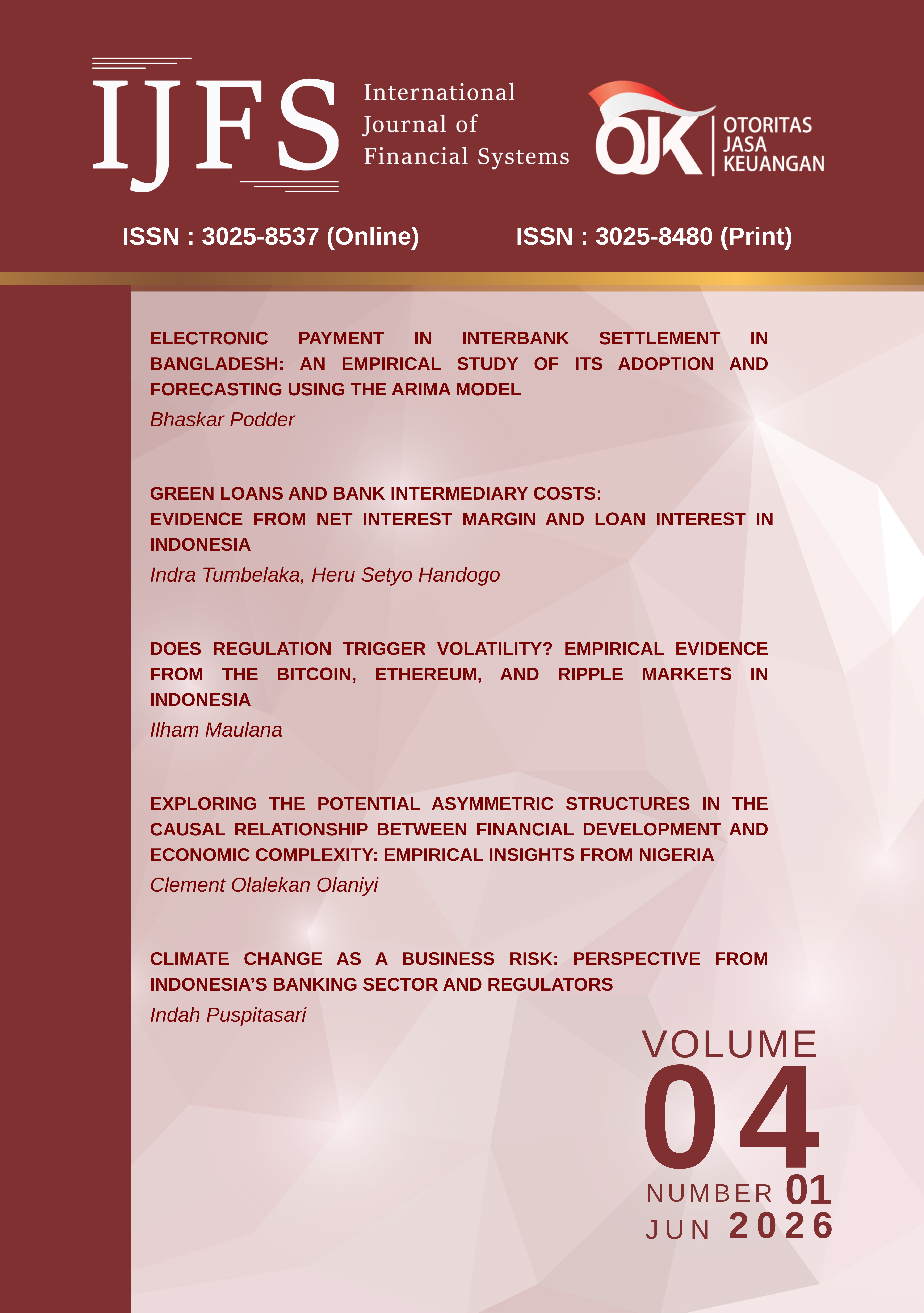
Maulana, I. (2026). Does Regulation Trigger Volatility? : Empirical Evidence from the Bitcoin, Ethereum, and Ripple Markets in Indonesia. The International Journal of Financial Systems, 4(1), 37–54. https://doi.org/10.61459/ijfs.v4i1.103
Issue
Section
Articles
License
Copyright (c) 2026 The International Journal of Financial Systems

This work is licensed under a Creative Commons Attribution-NonCommercial 4.0 International License.
IJFS article's license is CC-BY-NC. Authors grant the journal/publisher publishing rights with the work simultaneously licensed under a Creative Commons Attribution-NonCommercial 4.0 International License.