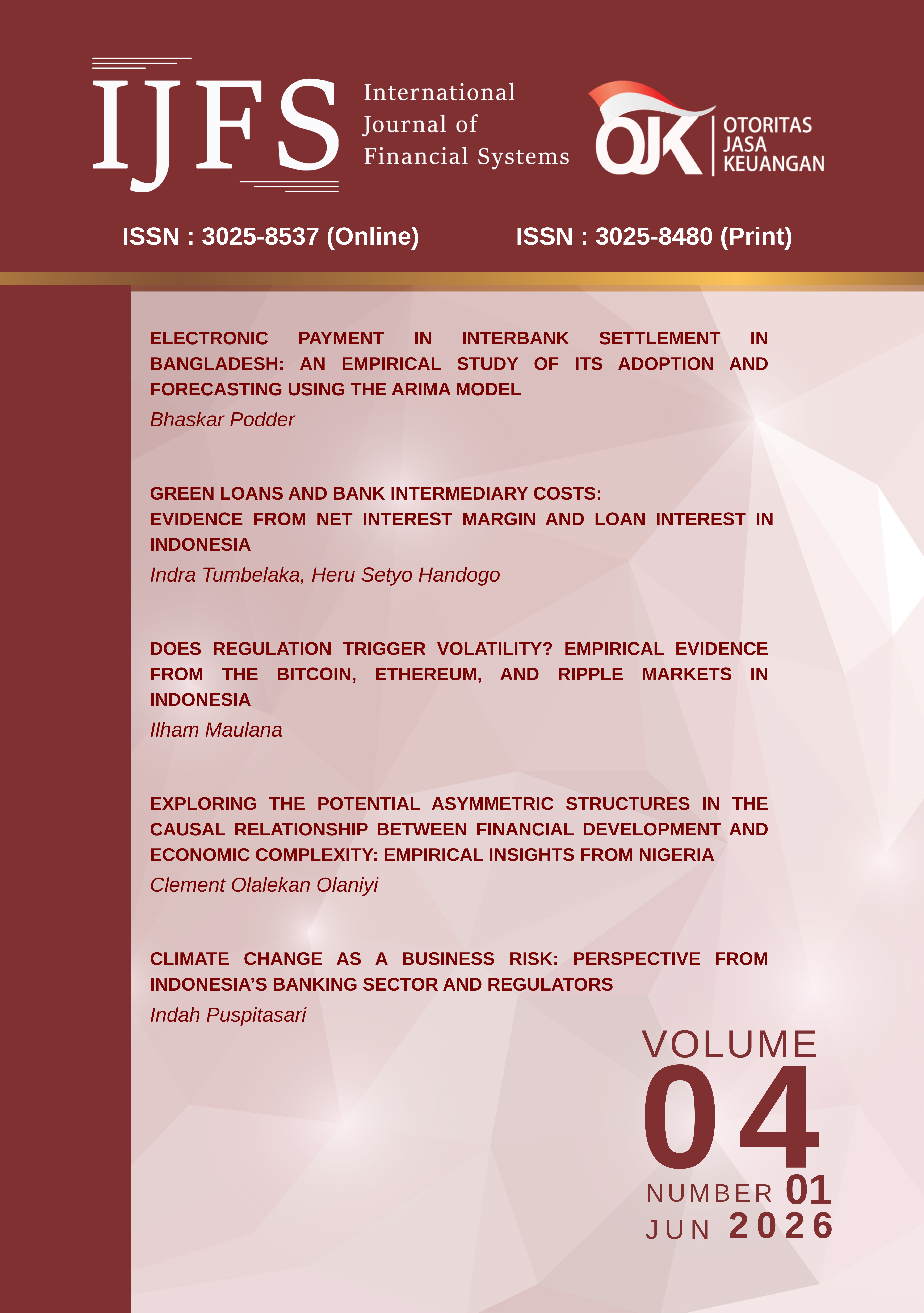
Electronic Payment in Interbank Settlement in Bangladesh:
An Empirical Study of its Adoption and Forecasting using the ARIMA Model
DOI:
https://doi.org/10.61459/ijfs.v4i1.115Keywords:
Electronic Payment, Electronic Settlement, Adoption, Innovation, RTGS, Digital BankingAbstract
For over a decade, the Bangladesh government, regulators, and commercial banks have been investing in the Electronic Payment and Settlement System (EPSS) to accelerate economic development, ensure financial stability, and promote financial inclusion. This study examines the adoption of EPSS in Bangladesh and forecasts its trend. The focus is specifically on a component of EPSS – the Real Time Gross Settlement (RTGS). We analyse the historical trend of EPSS and its traditional substitute in detail. The Box-Jenkins methodology is employed to develop an appropriate autoregressive integrated moving average (ARIMA) model for forecasting the increasing share of EPSS in Bangladesh. Our findings reveal that the share of EPSS will be 93.20% and 57.75% with respect to amount and number, respectively, after about three years. The adoption of EPSS with respect to amount shows a steeper upward trend than its adoption with respect to number. Because RTGS adoption is limited to a certain threshold, the number of small-amount transactions is still captured by traditional substitutes. A pervasive lack of digital financial literacy among a subset of the population also drives the adoption of traditional substitutes. Unlike prior works on digital adoption that are based almost exclusively on consumers’ perceptions, this study is grounded in actual data to investigate the adoption of EPSS and its forecasted trend at a country level. It highlights the effectiveness and shortcomings of EPSS in the context of an emerging economy. Our findings can assist policymakers in formulating strategic decisions for the adoption of electronic payment systems in emerging economies.
Downloads
Download data is not yet available.
References
Abonazel, M. R. & Abd-Elftah, A. I. (2019). Forecasting Egyptian GDP using ARIMA models. Reports on Economics and Finance, 5(1), 35–47.
Agrawal, M. & Bansal, A. (2018). Factors Influencing Consumer’s Intention to Use E-payment System: An Empirical Study. International Bulletin of Management and Economics, 9(1), 14–28.
Azam, M. S., Morsalin, M., Rakib, M. R. H. K. & Pramanik, S. A. K. (2021). Adoption of electronic commerce by individuals in Bangladesh. Information Development, 02666669211052523.
Bangladesh Bank. (2006). Bangladesh Bank Annual Report 2005-2006. https://www.bb.org.bd/pub/ annual/anreport/ar0506/index0506.php.
Bangladesh Bank. (2016). Bangladesh Bank Annual Report 2015-2016. https://www.bb.org.bd/pub/ annual/anreport/ar1516/index1516.php.
Bangladesh Bank. (2019). Bangladesh Bank Annual Report 2018-2019. https://www.bb.org.bd/pub /annual/anreport/ar1819/index1819.php.
Bangladesh Bank. (2022). Bangladesh Bank Annual Report 2021-2022. https://www.bb.org.bd/pub/ annual/anreport/ar2122.pdf.
Barnes, S. J. & Corbitt, B. (2003), “Mobile banking: concept and potential”, International Journal of Mobile Communications, 1(3), 273–288.
Box, G. E. P. & Jenkins, G. M. (1970). Times Series Analysis Forecasting and Control, Holden-Day San Francisco.
Bultum, A. G. (2014). Factors affecting adoption of electronic banking system in Ethiopian banking industry. Journal of Management Information System and E-commerce, 1(1), 1–17.
Chatfield, C. & Xing, H. (2019). The analysis of time series: an introduction with R. Chapman and hall/CRC.
Del Sarto, N., & Ozili, P. K. (2025). FinTech and financial inclusion in emerging markets: a bibliometric analysis and future research agenda. International Journal of Emerging Markets, 20(13), 270-290.
Dennis, A. (2004). Electronic Payment System: User-Centered Perspective and Interaction Design. Eindhoven: Technical Universiteit Eindhoven, 1–12.
Davis, F. D. (1989). Perceived usefulness, perceived ease of use, and user acceptance of information technology. MIS Quarterly, 319–340.
Dickey, D. A. & Fuller, W. A. (1979). Distribution of the estimators for autoregressive time series with a unit root. Journal of the American Statistical Association, 74(366a), 427–431.
Goodhue, D. L. & Thompson, R.L. (1995). Task-Technology Fit and Individual Performance. MIS Quarterly, 19(2).
Griffiths, P. D. R., Mukherjee, A., & Sinha, P. N. (2025). Determinants of Fintech diffusion in emerging markets: a service ecosystem perspective. International Journal of Emerging Markets, 20(13), 356-376. https://doi.org/10.1108/IJOEM-04-2024-0678.
Gupta, K. & Arora, N. (2020). Investigating consumer intention to accept mobile payment systems through unified theory of acceptance model: An Indian perspective. South Asian Journal of Business Studies, 9(1), 88–114.
Haralayya, B. (2021). How Digital Banking has brought innovative products and services to India. Journal of Advanced Research in Quality Control and Management, 6(1), 16–18.
Kabir, M. A., Saidin, S. Z. & Ahmi, A. (2015). Adoption of e-payment systems: a review of the literature. In International Conference on E-Commerce, 112–120.
Kumar, A. (2019). A Study of Significant Characteristics of E-payment Regime in India. MERC Global's International Journal of Management, 7, 168–174.
Ljung, G. M. & G. E. P. Box (1978). On a measure of lack of fit in time series models. Biometrika, 65, 297–303.
Nedozi, F. O. & Omoregie, C. I. (2019). An empirical evaluation of different electronic payment channels in Nigeria. Journal of Finance and Accounting. Special Issue: Financial Inclusion, Accounting Perspectives and Development, 7(5), 146–152.
Ongkasuwan, M. & Tantichattanon, W. (2002, October). A comparative study of Internet banking in Thailand. In First National Conference on Electronic Business, Bangkok.
Phillips, P. C. & Perron, P. (1988). Testing for a unit root in time series regression. Biometrika, 75(2), 335–346.
Podder, B. (2025). Mobile Financial Services in Bangladesh: An Empirical Study of its Usage. Global Business Review. https://doi.org/10.1177/09721509251333478.
Premchand, A. & Choudhry, A. (2015). Future of payments-ePayments. International Journal of Emerging Technology and Advanced Engineering, 5(1), 110–115.
Rogers, E. M. (1962). Diffusion of innovations. The free Press of Glencoe. NY.
Shumway, R. H. & Stoffer, D. S. (2017). ARIMA models. InTime series analysis and its applications (75-163). Springer.
Souiden, N., Ladhari, R. & Chaouali, W. (2021). Mobile banking adoption: a systematic review. International Journal of Bank Marketing, 39(2), 214–241.
Teoh, W. M., Chong, S. C., Lin, B. & Chua, J. W. (2013). Factors Affecting Consumer' Perception of Electronic Payment: An Empirical Analysis. Internet Research, 23(4), 465–485.
Venkatesh, V., Morris, M. G., Davis, G. B. & Davis, F. D. (2003). User acceptance of information technology: Toward a unified view. MIS Quarterly, 425–478.
World Bank. (2023). Payment Systems, https://www.worldbank.org/en/topic/paymentsystems remittances.
Xena, P. & Rahadi, R. A. (2019). Adoption of e-payment to support small-medium enterprise payment system: A conceptualised model. International Journal of Accounting, 4(18), 32–41.
Downloads
Published
06/30/2026
How to Cite
Podder, B. (2026). Electronic Payment in Interbank Settlement in Bangladesh: : An Empirical Study of its Adoption and Forecasting using the ARIMA Model. The International Journal of Financial Systems, 4(1), 1–16. https://doi.org/10.61459/ijfs.v4i1.115
Issue
Section
Articles
License
Copyright (c) 2026 The International Journal of Financial Systems

This work is licensed under a Creative Commons Attribution-NonCommercial 4.0 International License.
IJFS article's license is CC-BY-NC. Authors grant the journal/publisher publishing rights with the work simultaneously licensed under a Creative Commons Attribution-NonCommercial 4.0 International License.